

Most software does not start with code.
It starts with understanding.
That may sound obvious, but in practice we often skip this step. We get a task, open the editor, create a class, add a table, write an API, and start building.
That feels productive.
But sometimes we are only building fast because we have not yet understood the problem.
And when we do not understand the problem, the code will show it later.
What is a domain model?
A domain model is the way your software understands the real world.
It is not just a diagram.
It is not just a class.
It is not just a database table.
It is the set of concepts, names, rules, and relationships that your system is built around.
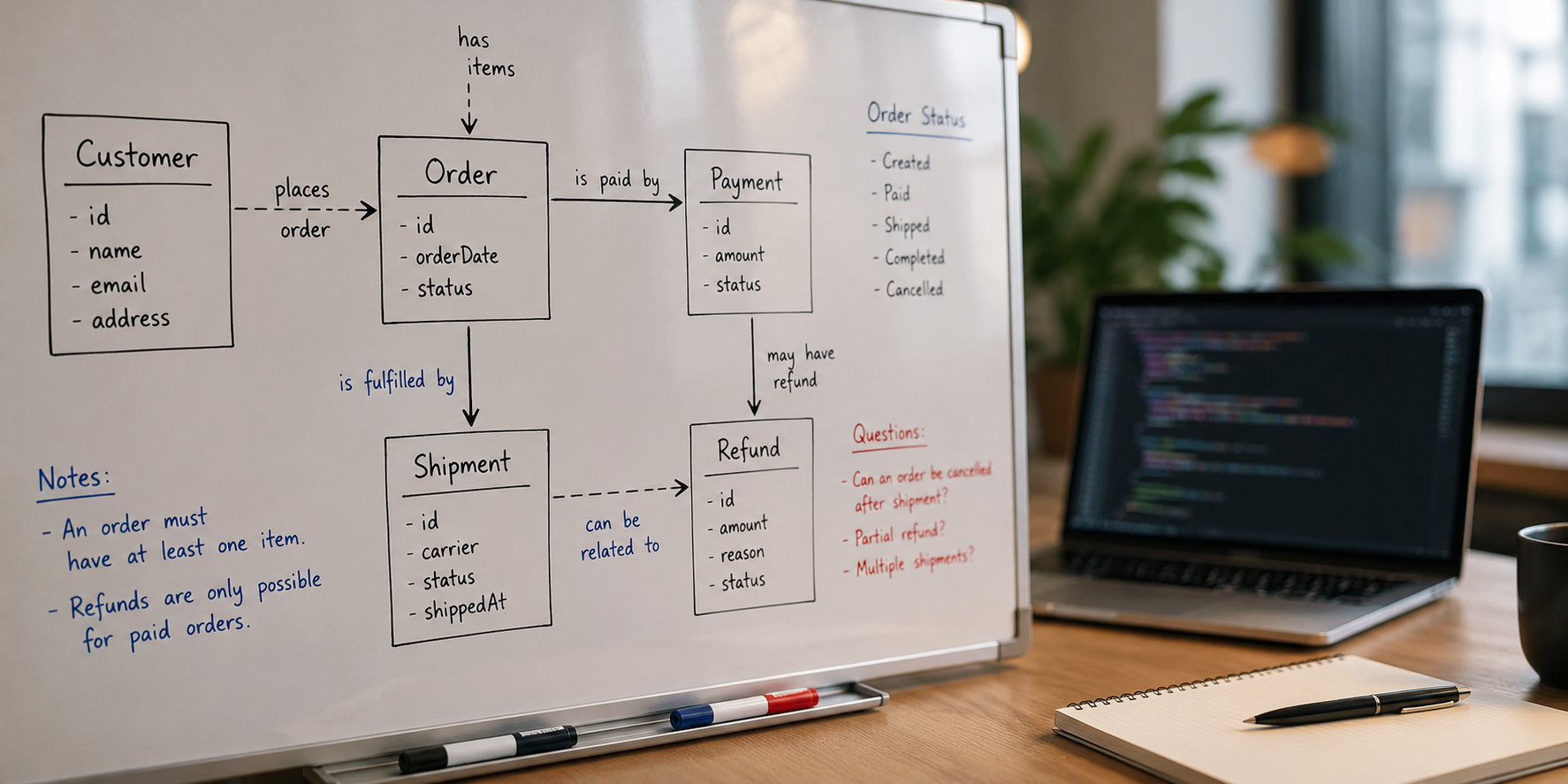
For example, if you are building a webshop, your domain has words like:
Order.
Customer.
Payment.
Invoice.
Shipment.
Refund.
Cancellation.
These words look simple.
But they are not always simple.
What is an order?
Is an order created when the customer clicks “buy”?
Or only after payment succeeds?
Can an order exist without a payment?
Can an order be partly shipped?
Can it be cancelled after it was shipped?
Is a refund part of the order, or part of the payment?
These questions are important.
Because the answers become code.
Coding is not always the hard part
Writing the code is often not the hardest part.
The hard part is understanding what the code should mean.
A beginning developer may think:
“Tell me what to build, and I will build it.”
That is normal. That is how many of us start.
But with more experience, you learn that the task description is often incomplete.
Someone says:
“Add a cancelled status to orders.”
That sounds easy.
So you add this:
public enum OrderStatus
{
    New,
    Paid,
    Shipped,
    Cancelled
}
Done, right?
Maybe.
But then the questions start.
Can a paid order be cancelled?
Should the customer get money back automatically?
What if the order was already shipped?
What if only one item in the order is cancelled?
Should the warehouse still see it?
Should finance still see it?
Should support still see it?
Suddenly, the simple status is not simple anymore.
The code was easy.
The meaning was hard.
Many bugs are misunderstanding bugs
Not every bug is a technical mistake.
Sometimes the code does exactly what the developer wrote, but the developer wrote the wrong thing because the team
misunderstood the business rule.
For example:
Support thinks “cancelled” means:
“The customer does not want the order anymore.”
Finance thinks “cancelled” means:
“No money should be collected.”
The warehouse thinks “cancelled” means:
“Do not ship this.”
But what if the order was already shipped?
Now the word “cancelled” means different things to different people.
If nobody clears that up, the system becomes messy.
You get extra flags.
You get exceptions.
You get strange conditions.
You get methods that do too much.
You get code that nobody wants to touch.
Not because people are stupid.
Because the model was unclear.
Good names are not decoration
In software, names are important.
A bad name can hide a bad idea.
For example, imagine a system where the same thing is called:
User in the code.
Customer in the database.
Account in the API.
Client in the user interface.
Maybe those are all the same thing.
But maybe they are not.
A user may be someone who logs in.
A customer may be someone who buys something.
An account may be a company.
A client may be a person receiving a service.
If the team uses these words randomly, the code will become confusing.
Good domain modeling means asking:
“What do we actually mean by this word?”
That question can save a lot of pain later.
The model shapes the code
Your domain model decides how your code wants to grow.
If your model is clear, your code usually becomes easier to understand.
Payment logic goes near payments.
Shipping logic goes near shipments.
Order rules stay with orders.
Refund rules are not hidden in random places.
But if your model is unclear, the logic spreads everywhere.
A controller checks payment rules.
A service changes shipping state.
A background job updates order status.
The frontend has its own rules.
The database has another version of the truth.
That is how systems become fragile.
At some point, nobody is sure what will break when they change something.
Frameworks do not fix bad understanding
Frameworks are useful.
Clean Architecture can help.
Microservices can help.
Events can help.
CQRS can help.
ORMs can help.
But none of these tools understand your business for you.
You can use good tools and still build the wrong thing.
A beautiful technical structure does not help much if the ideas inside it are confused.
That is why domain modeling comes before architecture.
Before asking:
“Should this be a microservice?”
Ask:
“What concept are we talking about?”
“Who owns this rule?”
“What does this state mean?”
“What can change?”
“What must never happen?”
These are engineering questions.
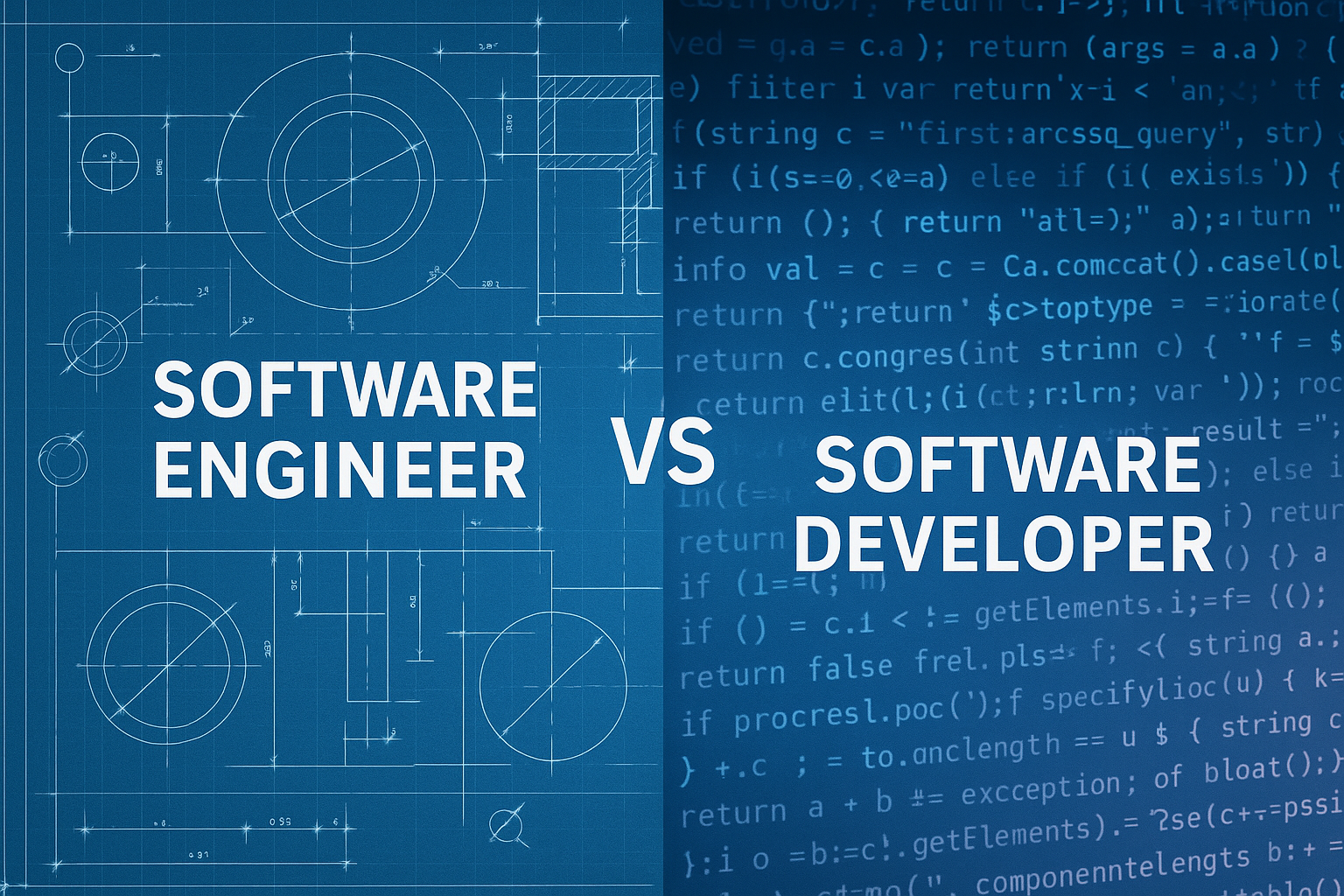
The difference between a developer and an engineer
A developer writes code.
An engineer also tries to understand the system behind the code.
That does not mean a developer is less valuable. Everyone starts somewhere. But it does mean there is a step in
growth.
At first, you learn how to write code that works.
Later, you learn how to write code that fits the problem.
That is a big difference.
A developer may ask:
“How do I implement this?”
An engineer also asks:
“Is this the right thing to implement?”
That question is not annoying.
That question is not slowing the team down.
That question is part of the work.
Of course, you can overdo it. You can talk forever and never build anything. That is not good either.
But jumping into code too fast often creates expensive problems later.
You can refactor code, but a wrong idea spreads
Bad code can often be refactored.
You can rename a method.
You can split a class.
You can move logic.
You can clean up duplication.
That is work, but it is possible.
A wrong domain model is harder.
Because the wrong idea spreads.
It spreads into the database.
It spreads into the API.
It spreads into reports.
It spreads into tests.
It spreads into team language.
It spreads into how users expect the system to work.
By the time you notice it, changing it is no longer just a code change.
It is a system change.
That is why understanding is important early on.
Domain modeling is not only for seniors
You do not need to be a senior architect to start domain modeling.
You can begin with simple questions:
What is this thing called?
What does it mean?
Who uses this word?
Does everyone mean the same thing?
What states can it have?
What is allowed?
What is not allowed?
What happens first?
What happens next?
Who owns this rule?
These questions make you better.
They also make your code better.
Even as a beginning developer, you can practice this.
Before you create a class, ask what real-world concept it represents.
Before you add a boolean, ask what state you are really modeling.
Before you add an enum value, ask what the transitions are.
Before you copy logic somewhere else, ask where the rule belongs.
This is how you grow from only writing code to engineering software.
Where software actually starts
Domain modeling is where software actually starts because software is not just code.
Software is a model of part of the real world.
A webshop models orders, payments, products, and shipments.
A bank system models accounts, transactions, balances, and limits.
A planning system models time, availability, bookings, and conflicts.
The code is how we express that model.
So if the model is unclear, the code will become unclear too.
That is why the real work starts before the first class is written.
It starts when we ask:
“What are we really building?”
Not just technically.
But conceptually.
Because before we can build the thing right, we need to understand what the thing is.
That is domain modeling.
And that is where software actually starts.
Further reading
This article was shaped by ideas from domain-driven design, software modeling,
and the practical experience that good software starts with understanding the
problem before writing the code.
- Martin Fowler: Domain Driven Design
A clear introduction to domain-driven design and the idea of placing the domain model at the center of software development. - Martin Fowler: Ubiquitous Language
Explains why developers and domain experts need a shared language, and why unclear words often lead to unclear software. - Martin Fowler: Bounded Context
A useful explanation of why the same word can mean different things in different parts of a system, and why those meanings need boundaries. - Eric Evans: Domain-Driven Design Reference
A free online reference with definitions and pattern summaries from the original author of Domain-Driven Design. - Thoughtworks: Domain-driven design needn’t be hard. Here’s how to start
A practical and accessible introduction for people who want to start with domain-driven design without drowning in theory. - DDD Starter Modelling Process
A practical step-by-step guide for applying domain-driven design thinking, from understanding the business model to coding the domain model.


Leave A Comment